
DEFOOR REPORT · AI NEWS
Jensen Huang Brings Four Robot Ducks On Stage in Berlin. A Day Later, Preorders Pass 20,000
Hugging Face's $399 Microduck sat, napped and tried somersaults at Nvidia's GTC Berlin keynote. Nvidia agreed in September to buy Hugging Face, the robot's parent company.
By the News Desk
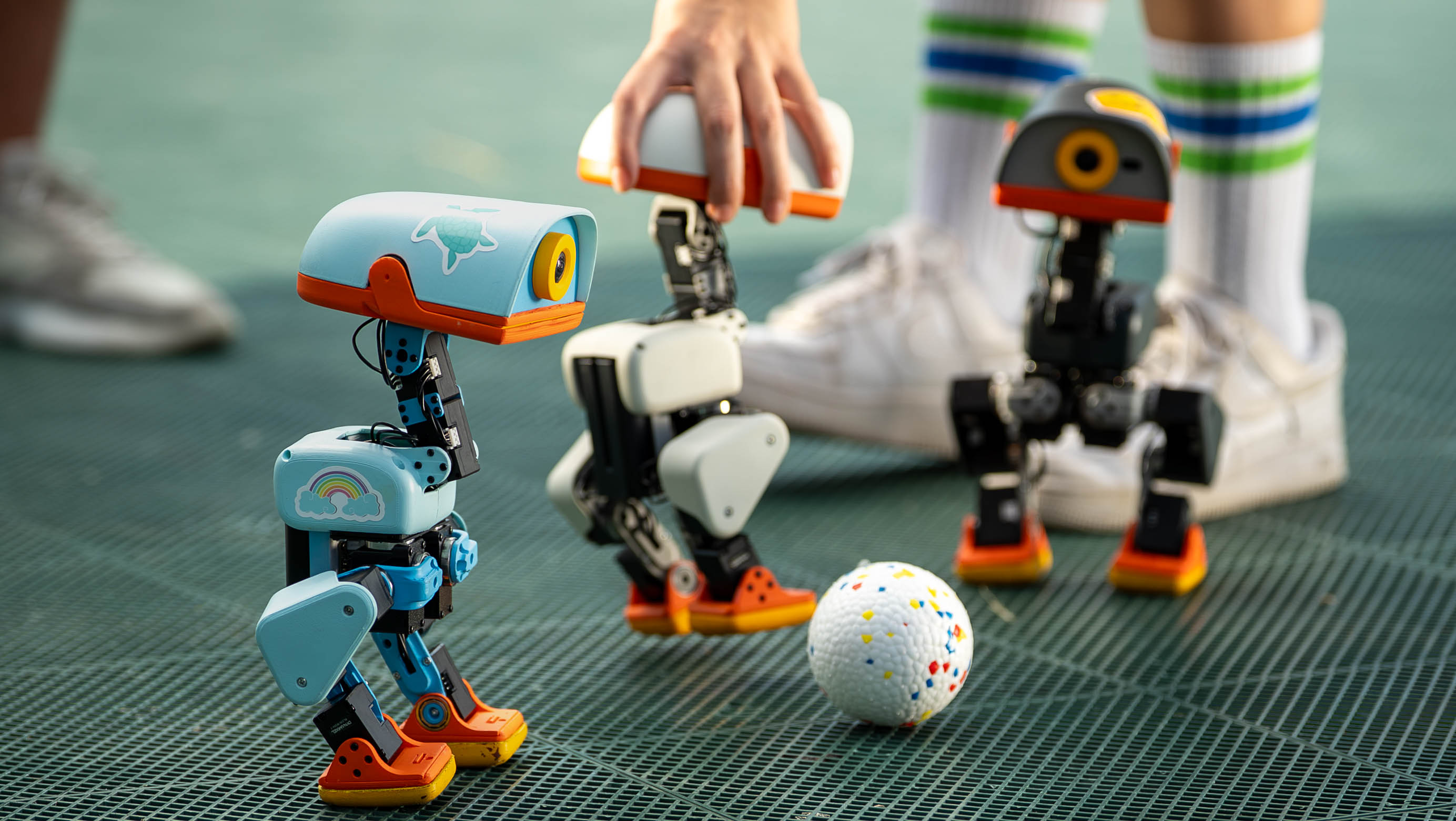
Nvidia CEO Jensen Huang shared the stage at GTC Berlin on Wednesday with four Microducks, the 25 cm walking robot from Pollen Robotics, Hugging Face's robotics team. By the next day, preorders had passed 20,000 units, Hugging Face CEO Clem Delangue said on X, TechCrunch reports.
What happened on stage
At the October 21 keynote in Berlin's Tempodrom, Huang told the ducks to sit, stand and take a nap. On the nap command, three fell over onto the floor. The fourth stayed on its feet.
Huang then explained that the ducks learned their skills on hardware Nvidia builds: trained on Nvidia supercomputers in the cloud, practiced in a digital twin, and tested on Nvidia's new RTX Spark PCs before going onto the robots.
Huang also asked for somersaults. A couple of the robots did one, and others needed more encouragement, Interesting Engineering reports. One duck wandered off, tripped and got back on its feet. Huang called it back: "Pay attention. Stay focused. Come here." It walked over and sat down.
The ducks answered each command quickly, and each one moved in its own way.
How the ducks learned
Huang also showed a video of an AI agent training Microduck, according to Nvidia's keynote recap. The agent set up a course, simulated the robot in Nvidia's Isaac Sim, sent the training jobs to Nvidia supercomputers in the cloud, and brought the learned skill back to an RTX Spark for testing before loading it onto the real robot.
Simulation is what makes that fast. In a virtual world a robot can practice thousands of times at once, with no wear on its motors and no risk of breaking in a fall, and the finished skill is then loaded onto the real robot. In Pollen's own open-source training code, 4,096 virtual Microducks practice side by side, and a usable walking gait takes about one to two hours on an Nvidia graphics card, according to Pollen's GitHub page. Owners can teach their ducks new tricks the same way, and Pollen's code can run the training on Hugging Face's cloud for anyone without a graphics card.
RTX Spark is Nvidia's new line of Windows PCs, launched the week before the keynote. Huang said each one delivers 1 petaflop of computing with 128 GB of memory.
The robot
From the Pollen Robotics press kit:
- 25 cm tall, 14 cm wide, under 800 g
- 15 motors across the legs, neck and head
- A front camera, a compact LiDAR depth sensor and two motion sensors
- A beak that picks up small objects
- Rockchip RK3566 processor with an AI accelerator, 1 GB of memory and 32 GB of storage
- A removable camera battery that runs about an hour per charge
- Seven trained moves and a game controller in the box, so it plays before anyone writes code
- $399 before taxes and shipping, with first deliveries targeted before Christmas 2026 in North America and Europe
Pollen releases the software as open source: the simulation environments, the training scripts and the steps for moving a trained skill from simulation onto the robot. The mechanical and electronic design files are not part of that release.
The sales run
- Aug. 27: Preorders open at $399.
- Sept. 1: Hugging Face tells CNBC it has sold more than 10,000 units and passed $5 million in sales.
- Sept. 3: Nvidia announces it has agreed to buy Hugging Face for $12.93 billion. The deal faces merger review in the United States and the European Union, Yahoo Finance reports.
- Oct. 21: Huang brings four Microducks on stage at GTC Berlin.
- Oct. 22: Delangue says preorders have passed 20,000.
Pollen's Microduck page still lists the robot for preorder at $399.
Who makes it
Pollen Robotics builds robots in Bordeaux, France. Former Inria researchers founded it in 2016, and it joined Hugging Face in April 2025. Microduck is its second consumer robot, after the Reachy Mini desktop robot.